Net Dynamic Menu by Vista-Buttons.com v4.3.0


       We are listed on
Last Minute travel deals - Sailing Vacation Auctions


Charter Crewed Yachts - the yellow pages of crewed yachts
CharterCrewedYachts.com

and

SailingVacationAuctions.com 

JustAnswer.com


Yacht Charter Guide


As Featured On EzineArticles  

Earthrace / Ady Gil R.I.P.


Earthrace/Ady Gil – Our collective loss

By: Scott Fratcher - Marine Engineer/Captain
Photos mostly by Lance Wordsworth

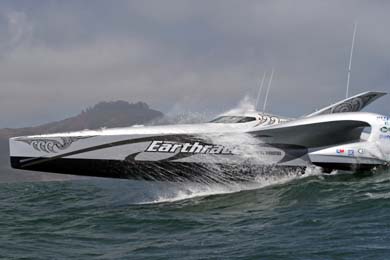
M/V Earthrace, the bio diesel-powered, wave-penetrating trimaran, was lost in the Southern Ocean on Jan. 5 after a collision with a Japanese whaling ship. Earthrace was designed by Craig Loomes, skippered by Pete Bethune and held the UIM round-the-world speedboat record. I served as Chief Engineer for Team Earthrace during her record attempt in 2007.

Writing a eulogy about Earthrace feels like writing about the loss of a famous relative. I knew her well, but she touched many more lives than I’ll ever know.

If the Japanese were seeking to reduce media exposure of whaling, they picked the wrong boat to eliminate. Earthrace, the world’s most high-profile powerboat, has been toured by more than 200,000 visitors in dozens of countries. Her loss has been viewed around the world, on every major news channel, by tens of millions of people.

The sinking of Earthrace symbolizes the end of an era. The end of a piece of history that many were hoping would land on the walls of the National Maritime Museum rather than the floor of the Antarctic Ocean.

Without a doubt, Earthrace suffered much drama during her short life. The news reports only told part of the tale. Take a look at some of the more memorable Earthrace moments with an insider's eye.


Funding

From its inception, Team Earthrace was desperately low on funds. Undaunted by the lack of a major cash sponsor, owner Pete Bethune capitalized on the idea of a thousand small-time funders. Opening up Earthrace for day tours at $5 a head, money trickled in and Earthrace formed a “hands on” public support group.

This simple concept of thousands of small day-to-day donations became the main funding source for Earthrace expenses and showed how a grassroots organization can effect change on a global scale.


Record attempt No. 1

In a crushing blow to the 2007 race effort, the main biodiesel sponsor pulled out (due to financial constraints) just a month before race start, leaving Earthrace with empty fuel tanks and 25,000 miles to go.

Bethune kept the boat on schedule while the ground team ran its own race seeking biodiesel donations tank by tank, often succeeding with just hours to spare. This saga climaxed in the remote island of Palau where Earthrace arrived with a broken engine, no biodiesel and no cash.


Carbon prop failures

On the unsuccessful 2007 record attempt, Earthrace tried to gain a tactical advantage with the use of carbon fiber props. Eighteen hours into the first leg, the high-tech propellers simply fell to bits, leaving Earthrace limping toward Panama and causing the team to seek an instant donation of new propellers.

Hytorq stepped forward and supplied Earthrace with props for the remainder of her race career. Fed Ex diverted a plane and delivered the new props at cost while Panamanian customs stayed open past midnight to ensure their safe arrival.

The props were changed at the dock while team members stood guard, keeping crocodiles at bay. Amazingly Earthrace was only delayed two days

.

Guatemalan collision

The most famous incident in Earthrace's history was the nighttime collision with a Guatemalan fishing boat. In the dark of night, Earthrace struck an open 22-foot, unlit, drifting fishing boat, causing the death of one Guatemalan crew member and injuries to another.

The five-day old props were destroyed and Earthrace was detained in the Puerto Quetzal military base for 10 days until a Guatemalan court found Bethune not guilty for the tragic accident.

Insurance helped to compensate the families for their loss and Hytorq kept technicians working round the clock building another set of propellers.

The boxes were air shipped to southern Mexico where team member Allison Thompson, escorted by a Guatemalan tourist office representative, crossed the border to a remote Mexican air strip past midnight, only to be told the airport was closed. Pleading their case they succeeded in collecting the props and drove through the night to return to the waiting Earthrace.


San Diego

Team Earthrace was faced with more delays due to after-collision repairs at the dock in San Diego. Crew members pulled both props and one bent 3-inch shaft while Earthrace floated at the dock.

The shaft was delivered to a machine shop minutes before it closed for a three-day weekend. Taken with the Earthrace project, local technicians stayed open through the night to straighten the shaft.


Palau

A piston failed half-way between the Marshall Islands and Palau, one of the world’s most remote islands, causing a 10-day delay while the team waited for parts to find their way through the complicated air routes.

During this time, Earthrace ran completely out of cash. To buy enough fuel for departure the team started a radio campaign and sold seats aboard the infamous boat.


India

Yachts rarely visit India, due partly to the complex bureaucracy involved. Initially asked to wait on an offshore buoy for 48 hours while paperwork was processed, Earthrace was eventually allowed to dock directly at the main shipping pier in Cochin, South West India.

Inside the Earthrace engine room, repairs were desperately needed. In the rough crossing from Singapore, the flexible engine mount studs had sheared, leaving the port engine hanging by the shaft and nearly lying in the bilge.

Meanwhile the Earthrace crew had arrived without visas and were restricted to the hot, stuffy boat. They soon became ill with “Dehli-belly”. The biodiesel delivery was detained at the state border for four days till it finally arrived only to be found unusable after failing onboard quality tests.


Mediterranean

Earthrace found some of her roughest weather just south of Italy. The steady pounding caused a forward transducer to implode, which opened a tear in the Earthrace bottom two meters long.

Earthrace arrived in Malaga, Spain, in sinking condition. In the belief an “in the water” repair might be possible, the bottom had some “quick fix” epoxy laid over the cracks and Earthrace departed only to return hours later leaking worse than ever.


Thus ended the 2007 recorded attempt.


Repairs

Out of funds and with Earthrace broken at the dock, Pete Bethune returned to New Zealand to recover. Luckily, the America’s Cup was taking place just 400 miles away. Earthrace limped into Valencia, Spain, just in time for Team NZ to win the Louis Vitton cup.

Photos of Earthrace next to the Team NZ boats circulated around the world and gave Earthrace needed publicity. The press clippings were shown to the newly opened Vulkan Shipyard with its extra-wide travel lift, one of the only haulouts suitable in all Europe.

A sponsorship package was made with Vulkan Shipyard to supply a free haul and a safe haven to make repairs. With help from members of South Africa’s Team Shosholoza, Earthrace was re-launched a month later and departed for Ireland.


Stuck in Cork

Earthrace started her European “comeback tour” in Cork, Ireland. Trying to pass under the historic Eamon de Valera Bridge at low tide, she became wedged. With the tide turning and the threat of being crushed under the bridge imminent, the relief skipper gunned the engines and burst free to a hero's welcome in a cloud of cement dust and carbon fiber particles.


Cash sponsorship

Earthrace finally found a cash sponsor at the Rostock sail festival in the form of a German businessman. As a test of her advertising potential, Earthrace was re-branded with a large banner placed over her bow after which she lead the opening ceremony of Europe’s largest tall ship festival.

In the two-hour parade, the DucheMed sticker produced an incredible 50,000 Web site hits. For the remainder of the European tour, Earthrace showed off the new logo, providing needed resources for the 2008 record attempt.

Record attempt No. 2

Earthrace started her 2008 recorded attempt from Vulkan Shipyard, making good time till she arrived at the entrance to the Panama Canal. A “work to rules” work stoppage was in effect by canal employees causing a predicted two-week delay. After two days, canal authorities bowed to public pressure and allowed Earthrace quick passage across the isthmus.


Palau disaster

Earthrace arrived in the dark of night to the reef-strewn waters of Palau. After fueling, Earthrace departed into the darkness following a pilot boat where she struck a propeller on an unknown object, destroying a prop and shaft and cracking the P bracket. The team was devastated, and the record attempt again in peril. Earthrace departed on one engine for Singapore.


Emergency repairs

The Earthrace ground crew arrived in Singapore four days ahead of Earthrace with no funding and no haul-out plans. Throwing themselves on the good graces of the Singaporean business community, they arranged a haul out, new shaft, and P bracket repair mostly locally sponsored. Amazingly, Earthrace only suffered a two-day delay while round-the-clock repairs were completed.


Valencia and a new record

Earthrace crossed the finish line setting a new UIM record for the circumnavigation of a power boat, of 60 days, 23 hrs, 49 minutes, beating the old record time of 74 days, 23 hours, 53 minutes (held by Cable and Wireless). She brought home to New Zealand another noteworthy record.


Victory tour

Earthrace began a round-the-world victory tour drawing large crowds to visit the famous boat and hear lectures of education, individual responsibility, alternative energy and biodiesel. Dogged by heavy debt, Earthrace was put up for sale and eventually purchased by the Sea Sheppard Conservation Society, a radical anti-whaling group that practices direct action.

In other words Earthrace, renamed Ady Gil after the entertainment industry executive who donated the money to purchase her, was to be put “in harms way” in an effort to slow the Japanese whaling of the Antarctic.

Her sinking

Earthrace was refit for the Southern Ocean with extra layers of Kevlar, a powerful new radar, and painted black. Renamed Ady Gil she departed Australia for the Antarctic in an attempt to dissuade the Japanese whaling fleet.

After days of harassment from both sides, Earthrace was rammed by the whaling ship Shonan Maru No. 2, and sunk.

Filmed from three angles in the remote Antarctic Ocean, the ship-to-yacht collision footage on YouTube was viewed more than 2 million times in the first three days of posting.

Thus ended the glorious life of one of the world’s most controversial boats.


Conclusions

Some say Earthrace being dramatically rammed by a Japanese whaling boat on live TV is a fitting ending to the world’s most high-profile powerboat. During her race career, Earthrace was larger than life and, constantly displayed to a worldwide audience. How could her final moments be any less grandiose?

Scott Fratcher served as Chief Engineer for the 2007 record attempt and has authored six books including “Earthrace-First Time Around”


Earthrace busting through the waves

Earthrace with the Cork Castle


Ask a Marine Mechanic Online

We have partnered with JustAnswer so that you can get an answer ASAP.

JustAnswer


Click here to purchase

"Earthrace-First time around"
by Scott Fratcher

Download Now for just $9.00


Download Now

"Earthrace Operators Manual"

Download for just $6.00


Articles originally published in
Trade-aboat


Recommended forums


weldingweb.com

www.c34.org

www.diygokarts.com

www.worldwidedx.com

www.millerwelds.com/

SSCA Discussion Board


   © Team Yachtwork 2009